

Walking: The Most Underrated Exercise
Issue #243 You already know how to do it.


I have trained for fifteen years now. Weights, mobility work, long stretches of discipline that most people call excessive. But if someone asked me for one habit to build a body and a mind that last, I would not point to any of that.
I would point to walking.
Hippocrates called it a man’s best medicine, more than 2,400 years ago. We forget this because walking asks for nothing. No membership. No equipment beyond a comfortable pair of shoes. No skill you do not already have. You learned it at one year old, and your body has been asking you to keep doing it ever since.
Why the body loves it
Every step you take keeps one foot on the ground. This is the quiet reason walking is gentle on your knees and spine, unlike running, where both feet leave the ground at once and your joints absorb the landing.
But the real case for walking is in the data.
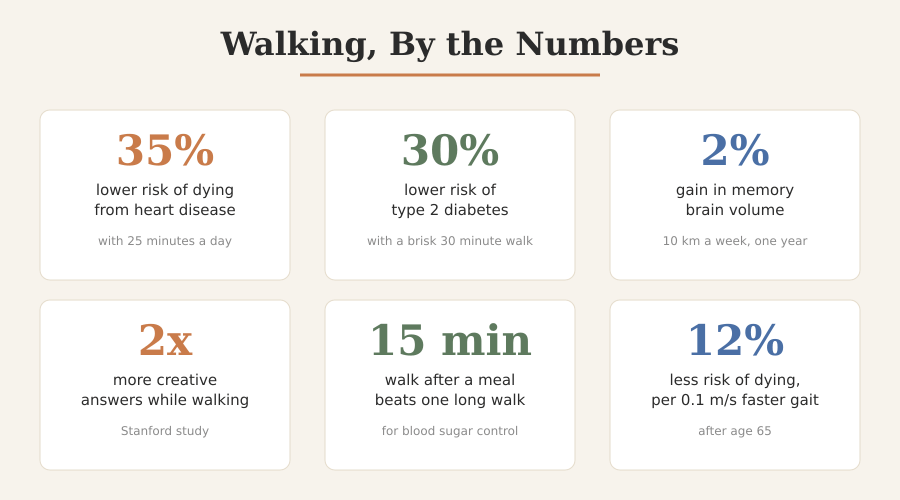
Harvard researchers followed more than 70,000 women for eight years. Those who walked three hours a week cut their risk of dying from heart disease by 35 percent. It did not matter if they started the study inactive. The moment they began to walk, the risk began to fall.
A brisk 30 minute walk a day cuts the risk of type 2 diabetes by 30 percent. And if you already carry that risk, timing matters more than duration. A 15 minute walk right after a meal controls blood sugar better than a single 45 minute walk in the morning. The body responds to when you move it, not only how long.
Walking lowers blood pressure. It strengthens bone, which means fewer fractures as you age. It even fights back against genes that predispose you to obesity. Harvard studied 32 such genes across 12,000 people and found that an hour of brisk walking a day cut their effect in half. Genes load the gun. Walking, it turns out, can still take your hand off the trigger.
Why the mind loves it
The hippocampus, the part of the brain that holds memory, shrinks by 1 to 2 percent a year once you cross into older age. One study found that walking 10 kilometers a week for a year did not just stop this shrinkage. It reversed it, adding back 2 percent in volume.
Walking lifts mood too, and not in a small way. For a 16 week stretch, researchers found it worked as well as medication for people managing depression.
And it makes you sharper in the moment. Stanford found people produce twice as many creative answers to a problem while walking than while sitting still. The effect does not end when you sit back down. It carries into whatever comes next.
I write early in the morning, in silence, before the house wakes up. Some of my clearest thinking has never happened at that desk. It has happened on a walk, when the mind is loose enough to wander somewhere useful.
How you walk matters
Speed is not vanity here. It is data.
Researchers at the University of Pittsburgh pooled results from nine studies covering nearly 35,000 people over 65. Every 0.1 meter per second increase in walking speed lowered the risk of dying by 12 percent. People walking at 3.5 km an hour or faster outlived what their age and gender would predict. And when a group of people over 65 improved their walking speed over a year, only 32 percent of them died over the following eight years, against 49 percent of those who stayed at the same pace.
Form helps you get there
.
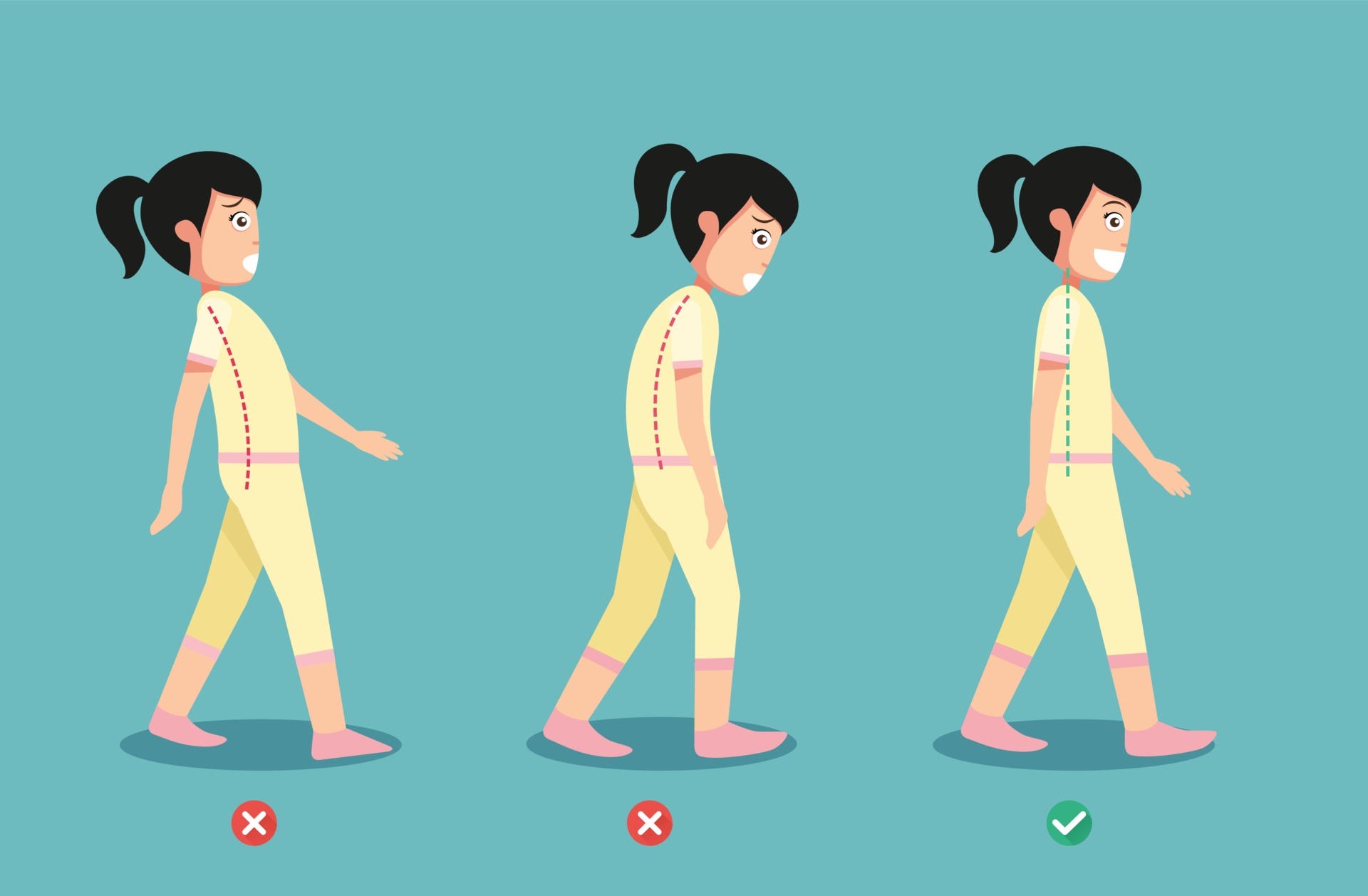
Stand tall. Let your spine lengthen, as if lifted from the crown of your head. A hunched walk is a tired walk.
Eyes up. Look 10 to 20 feet ahead, not at your feet. Your neck and back will thank you.
Shoulders back and down. Away from your ears, not toward them.
Let your arms swing from the shoulder, like a pendulum, not from the elbow.
Step light. Roll from heel to toe. Do not reach your leg far ahead of you. That slows you down and stresses your joints.
None of this is complicated. It is attention, applied to something you already do.
How much is enough
The standard guidance is 150 minutes of moderate walking a week, or about 30 minutes on five days. But do not let the number become a reason to skip a shorter walk. Research is consistent on this point: some is always better than none, and more is better than some. Walk longer or faster when you can. Walk at all when you cannot.
Walking for weight loss
Here is a fact worth sitting with. Walking is the single most common form of exercise among people who have lost weight and kept it off. The National Weight Control Registry tracked more than 5,000 people who lost an average of 66 pounds and kept it off for five and a half years. When researchers looked at how they stayed active, walking led the list. More than half of them walked a mile or more every day.
So walking works. But if the scale is your goal, one foot in front of the other is only the starting point.
If you are beginning from the couch, a leisurely stroll around the block, or simply adding steps through the day, will move the needle at first. But the body adapts fast. Repeat the same walk day after day and the weight loss will stall. To keep it moving, you need to change something: go farther, go faster, or go more often.
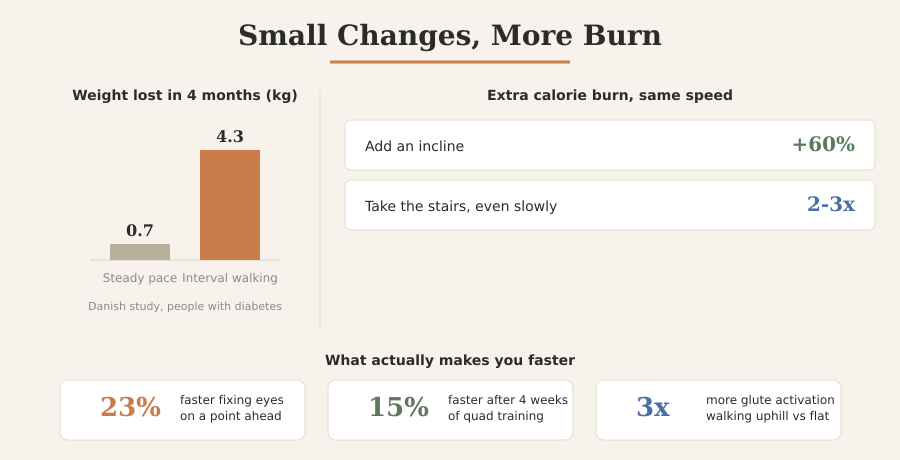
If a faster pace for the full walk feels like too much, break it into intervals instead. In a Danish study, people with diabetes who walked in intervals for four months lost six times as much weight as those who kept a steady pace, 9.5 pounds against 1.5, along with more belly fat.
Go faster. Calorie burn rises with speed, and the real gains start once you cross about 6 km/h. The instinct is to lengthen your stride, but that is not the answer. Quicker steps, a tall posture, and a proper heel to toe roll build speed better than a longer reach ever will.
Fix your eyes on a point ahead. Researchers found that walkers who focused on a cone in the distance moved 23 percent faster to reach it than walkers who let their eyes wander. And they found the walk easier, not harder, despite the pace.
Strengthen your legs. A strong core and strong glutes power a fast stride. In one study, women in their early sixties who trained their quadriceps for four weeks walked up to 15 percent faster afterward.
Stretch your hip flexors. Tight muscles at the top of the thigh cut short your stride and limit your push-off. Flexibility is speed you are leaving on the table.
Find a hill. Walking uphill activates three times as many muscle fibers in the glutes as level ground, and raises your calorie burn by about 60 percent at the same speed. If hills are scarce, incline on a treadmill does the same work.
Take the stairs. Even at a slow pace, climbing stairs burns two to three times more calories than walking on flat ground. Coming down does not offer the same return.
None of this asks you to run. It asks you to walk with intent instead of walking on autopilot.
Pitstop
Before you move to the next thing, sit with this for a moment.
When did you last take a walk with no destination and no podcast, just to think?
Is there a hard conversation you have been avoiding, one that might go easier side by side than face to face?
What would change if you treated your evening walk as unmissable, the way you treat a client call?
If your walk has stayed the same for months, what is one small change, a hill, an interval, a faster pace, you could try this week?
Walking will not make headlines. It will not look impressive on anyone’s timeline. But it is one of the few things that is free, available to almost everyone, and backed by decades of evidence that it adds years to your life and life to your years.
Put on the shoes. Step outside. The rest takes care of itself.
— Rearview
⏮ Missed Last Week? Here’s What Hit Home
The System Trained You to Be an Employee - Not an Employer

A few years ago, I was neck-deep in work when the receptionist called.
If you like this newsletter you have a zero cost way to support it by sharing with your friends and family and giving a shout out on your social media platform. On Twitterand Facebook or if you have received it as a forward please Subscribe.. Please leave your feedback and suggestions. You can mail me at me@sandeepmall.com or tweet to@SandeepMall using #goodvibeswithSandeep.
Meet you on the Twenty Ninth Sunday (29/52) of 2026. Take care
Great points here! And I'm glad you mentioned that at least 30 minutes a day. lol. That's how much I can walk for now because of all the things I have to balance. I don't really consider walking as my "exercise" but it's something I should do each day. This morning, I woke up at 5:00 AM and by 5:10, I was already walking on my walking pad. Nothing can go wrong when you start your day with walking :)