
The Optimisation Trap
You might live a little longer. But will you have actually lived?

The word “optimised” is doing a lot of work right now. It shows up in podcasts, on supplement labels, in the language of influencers with impossibly low body fat percentages and morning routines that begin at 4:47 a.m. It implies you’ve cracked something the rest of us haven’t - that while everyone stumbles through life on factory settings, you’ve found the configuration that extracts maximum performance from your one and only body. More energy. Sharper mind. A longer runway. And the more you hear it, the more it starts to feel less like a choice and more like an obligation - as though not optimising is a form of quiet self-neglect.
But here’s what nobody puts in the thumbnail: optimisation has a price, and that price is your life. Not your lifespan - that might actually inch upward by a few years. Your life. The spontaneous dinner invitation you say yes to without checking your macros. The slow Sunday morning with no agenda. The mental bandwidth to think about something - anything - other than your own biology. These are not small things. These are the things that, on reflection, tend to be the whole point.
The Seduction Is Real And Worth Understanding
It would be easy and dishonest to dismiss the appeal. Most of us genuinely want to feel better. We want more energy for the people we love, more clarity for the work that matters, more years to do the things we haven’t done yet. The desire to take health seriously is not vanity. It’s intelligence. The problem isn’t the impulse. The problem is where the industry takes that impulse and how far past the point of returns it leads you.
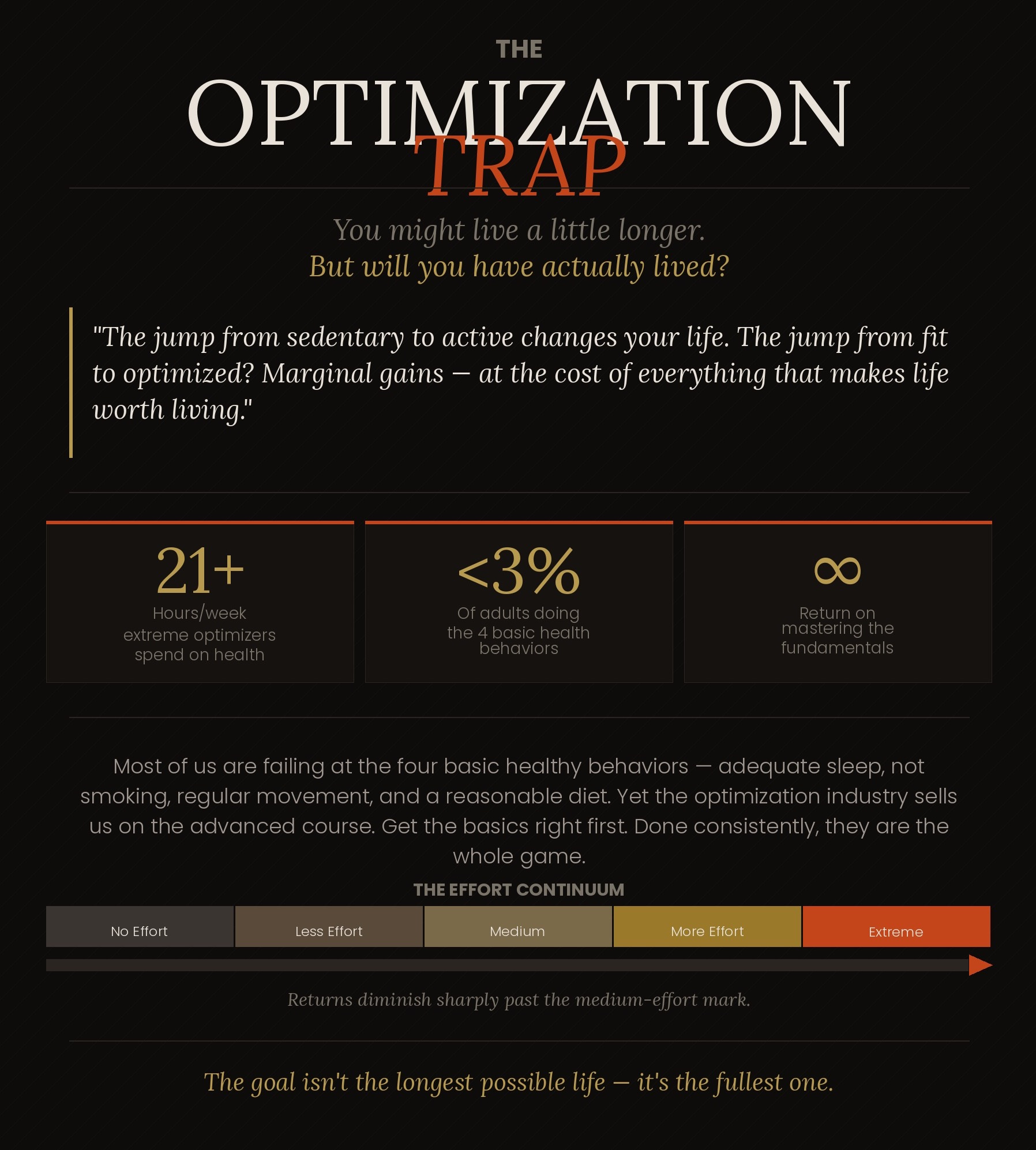
Health exists on a continuum. At one end, near-zero effort: little movement, poor sleep, processed food, chronic stress. At the other, extreme optimisation: 90-minute daily training sessions, continuous glucose monitoring, a stack of 10+ supplements, cold plunges, red light panels, VO2 max testing, and a relationship with food that has more in common with a spreadsheet than a meal. What the data shows is that the biggest returns happen early. Move regularly, sleep seven to eight hours, eat mostly real food, don’t smoke. Do those four things consistently and you’ve captured the overwhelming majority of what good health has to give you. Everything after that is the law of diminishing returns in slow motion.
The jump from sedentary to active changes your life. The jump from fit to optimised? Marginal gains at the cost of everything that makes life worth living.
Extreme optimisers spend upwards of 21 hours a week on health behaviours. That’s half a second job - except the currency isn’t money. Hours that aren’t spent in conversation with someone you love, or lost in a book, or doing the kind of aimless wandering that turns out to be where your best ideas live. Once spent, that time doesn’t come back. And no supplement stack offsets the compound interest of a life not fully inhabited.
The Irony Nobody Talks About
Here is what makes the entire conversation slightly surreal: research consistently shows that fewer than 3% of adults actually practice the four foundational healthy behaviours consistently. Not the advanced course. The basics. Adequate sleep, not smoking, maintaining a reasonable weight, moderate regular exercise. Just four things and we are collectively, spectacularly failing at them while the optimisation industry sells us on biohacking our way to longevity.
It’s the equivalent of struggling with multiplication tables while signing up for a calculus masterclass. The fundamentals aren’t glamorous. They don’t make for compelling content. Nobody goes viral for going to bed at a sensible hour or taking a 30-minute walk. But they are where almost all of the magic lives and mastering them, really mastering them as daily nonnegotiable rather than intermittent intentions, is a more meaningful act of self-care than any optimisation protocol you’ll find on the internet.
The five dimensions of wellbeing - social, physical, mental, emotional, and existential - are deeply interconnected. Extreme optimisation tends to serve one dimension while quietly starving the others. The person who never misses a training session but has slowly disappeared from dinners, from unstructured time, from the texture of ordinary life, has not optimised their wellbeing. They’ve traded a richer life for a narrower one with better metrics.
What Actually Matters
A life well-lived is not a performance review. It cannot be fully captured in resting heart rate, sleep scores, or biological age estimates. Those numbers can be useful - as information, as feedback, as gentle nudges. But when they become the point rather than the tool, something has gone wrong. You were not put here to optimise. You were put here to live with all the mess, spontaneity, and beautiful inefficiency that entails.
The invitation, then, isn’t to stop caring about your health. It’s to care about it in the right order. Get the basics right first. Get them deeply, consistently, sustainably right. Build the habits that require so little willpower they’ve become invisible. Then, from that stable foundation, ask yourself honestly: do I want to go further? Not because an influencer made it look compelling. Not because you’re afraid of what stopping would mean. But because, having weighed the real cost against the real gain, you’ve decided it’s genuinely worth it to you.
Most of the time, you’ll find the answer is: the basics, done well, are enough. More than enough. They are, in fact, the whole game and the life you build around them, unhurried and fully inhabited, is its own kind of extraordinary.
THE GOAL ISN‘T THE LONGEST POSSIBLE LIFE · IT‘S THE FULLEST ONE
⏪ Missed Last Week? Here’s What Hit Home
If you like this newsletter you have a zero cost way to support it by sharing with your friends and family and giving a shout out on your social media platform. On Twitterand Facebook or if you have received it as a forward please Subscribe.. Please leave your feedback and suggestions. You can mail me at me@sandeepmall.com or tweet to@SandeepMall using #goodvibeswithSandeep.
Meet you on the Twentieth Sunday (20/52) of 2026. Take care