
Bastard Writers
Issue #227 Guest Issue

Welcome to a very special edition of Good Vibes.
As we continue our journey of intentional living and reflection, I am excited to open up this space to voices that have profoundly shaped my own path. To kick off this guest series, I couldn’t think of anyone more fitting than the man who has been the silent engine behind my growth as a writer over the last fifteen months: Mudar Patherya.
Mudar is more than a mentor; he is the force that challenged me to dig deeper, helping me find the clarity and voice that eventually became my upcoming book, Rearview. He has a way of looking at the world and at words, that is entirely his own.
When I asked him for a bio, he sent over a self-portrait that is as eclectic and honest as the man himself
About Mudar Patherya
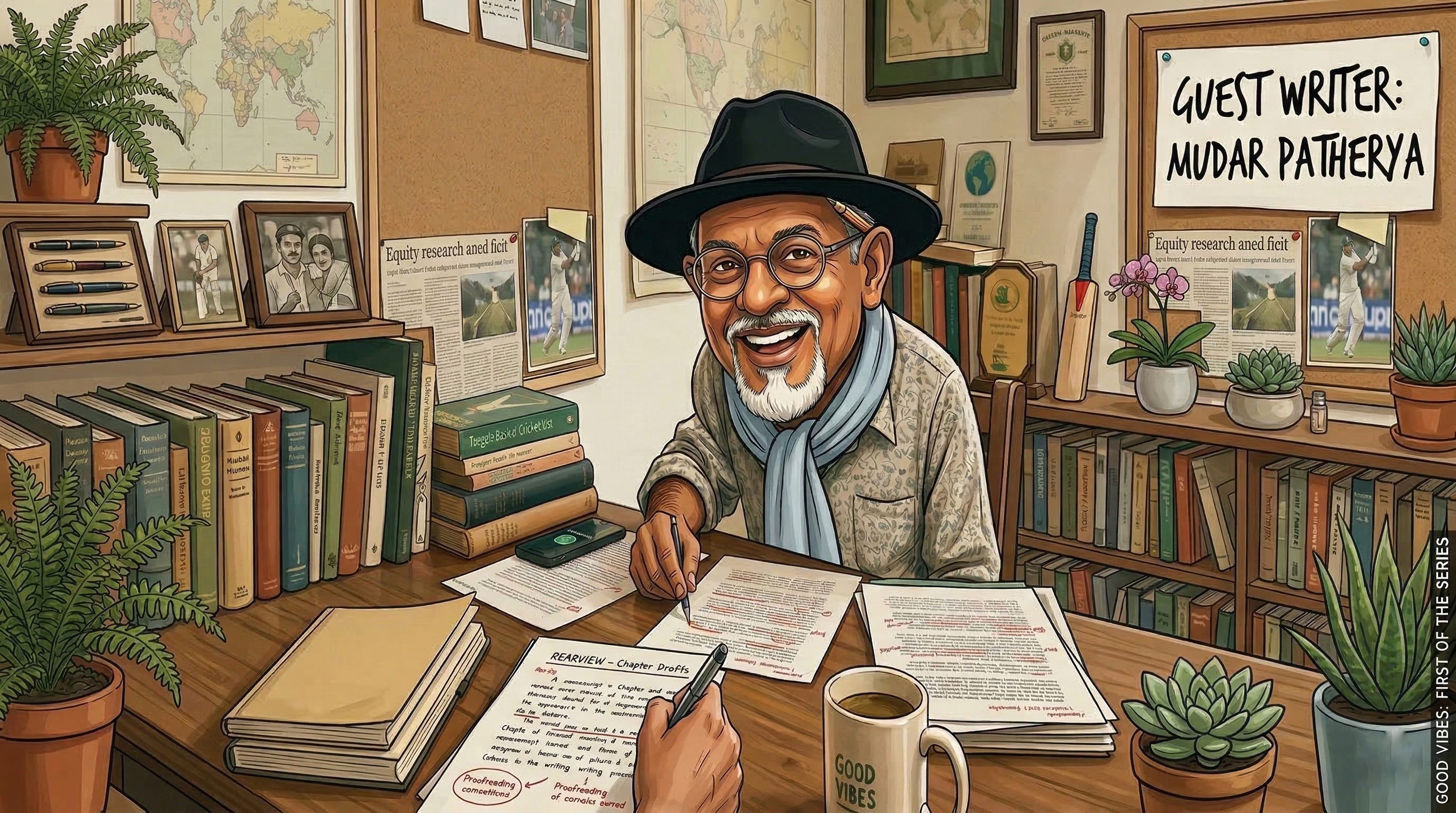
Contemporary storyteller who lives in the past. Garbage picker who has been out of work. Protestor seeking new causes. People networker fixated on the cellphone. Wannabe philanthropist scared of giving money away. Tree-erector praying for crane-owners. Columnist seeking editor introductions. Urdu-phile who can’t read the script. Pep-talker in search of an audience. Collector of things people consider useless. Worked for ABP at 18 but never got a salary slip. Imran Khan’s one-time ghost-writer who has not seen him in 36 years. Among Penguin India’s earliest authors (Penguin Book of Cricket Lists) who was never asked again. Wrote two books before 24 that disappeared without a trace. Started one of India’s first equity research outfits, disbanded after the market collapsed. Cleaned Santragachhi Jheel twice but the hyacinths returned. Helped turn Rabindra Sarobar around before the NGT kicked him out. Pioneered the creation of India’s Annual Report sector but most employees left to become competition. Writes 1.2 million words a year but cannot run 100m without panting. Describes proof-reading as meditation but takes an eye-drop for glaucoma. Responds to whatsapps within three minutes but has been putting off a diet for years. Collected and distributed 11,000 saris to the marginalized but hasn’t brought the wife one in 32 years. Interrupts conversations but calls himself ‘introvert’. Uses the word ‘amazing’ 36 times a day but gloats on being creative. Born in 1962 but calls himself young.
He is reachable at mudar@trisyscom.com
I hope his insights on the craft of writing inspire you as much as they have guided me.
Bastard Writers.
Politeness has ruined billions of sentences.
Because a writer is fundamentally bad-tameez. Someone who trespasses — into lives and moments best left alone.
Because a writer notices too much, remembers too much, and dares too much.
The tragedy is that even as this role is powerful, people speak, complain, think, scroll, observe — but not write.
Because if they cannot write well - in their opinion – they opt not to write at all.
But the objective of writing is not to write well. It is to write.
Write badly. Write clumsily. Write fragmented.
But write.
The blank page is the most intimidating maidan-e-jang.
Most people surrender before their first word. Kya likhe, they say. Kuch samajh me nahin aa rahaa.
Most believe that good writing must arrive dressed — wearing polished grammar, elegant structure, and sparkling vocabulary.
Good writing begins in a humbler place. Authenticity.
A man going through a relationship break-up might write: ‘Ghar kaatne ko daudta hain.’
No metaphors of autumn leaves, raining tear drops or festering wounds.
That one sentence carries more emotional neurons than a page of crafted prose. Why? Because that sentence carries haqeeqat. That sentence carries saans. That sentence carries larzish.
So what is good writing?
Good writing is writing that people read. That may sound simple, but in an age of distraction, it is an achievement. The modern reader lives in notifications, messages, headlines, reels, and scrolling. Attention is rare currency.
If someone reads your sentence and chooses to read the next, the remarkable begins.
If the person reads line after line, page after page, you may have extended into a new territory.
You are then not merely a writer. You are a conductor of emotions.
You are symphonising an orchestra of curiosity, anticipation, rhythm and surprise. You are deciding when the violins should whisper and when the drums should thunder.
You are, in a way, Gukesh across the board — thinking three moves ahead. Each sentence anticipates. Each paragraph opens doors.
Good writing is about observation. Most people see; a writer perceives.
Most people walk past a chai ka dukaan and see a man sipping. A writer captures more: the man holds the glass not from the sides but from the rim. A writer notices how he ‘phookoes’ his cooling breath on the surface. A writer notices the burn mark on the wooden counter where thousands of glasses have been placed. A writer notices that the tea vendor wipes all glasses with a cloth that has now turned a permanent tannin.
Writing revels detail. A good memory is the writer’s khazana: the creaky monotony of the midnight ceiling fan, rainwater pooling into a broken tile, a fleeting half-second of an expression.
Engagement deepens that magic. The reader should feel that the writer is speaking almost directly — as if sitting across a table. If the reader begins to anticipate the rhythm of the writer’s thinking, the powerful has happened.
Then comes thought clarity. Good writing leaves the reader with a big thought. Not five. Not seven. One.
The reader should feel the echo of that single idea. That idea may disturb, soothe, provoke, or inspire—but it must be one. When writers attempt to say everything, they usually say nothing.
Safe writing does not survive; bold writing does.
If a word needs to be repeated, repeat it. If a sentence needs to appear twice, try.
Writing is intelligence having fun; not intelligence imprisoned.
A misunderstanding about writing is this: good writing must be complex. Good writing is simple. Not simplistic—simple. RK Narayan-like. It flows. The reader wades effortlessly. Sentences breathe.
There is another rule: one must give oneself permission to write terribly. Write badly. Write horribly. Write illogically. Write incoherently.
This freedom unlocks better writing. Once the khauf dissolves, language loosens. Ideas flow. The page stops being an enemy.
Writing is also about music. Words possess sound. Sentences seed rhythm. Paragraphs carry cadence. A writer must read one’s own sentences aloud. Not to impress, but to sense the phonetic. Do sentences stumble? Do they segue naturally? Do they tune?
If they sound right, they will read right.
Some of the most zinda-dil writing comes from lingual fusion. English may create the sentence structure; another language may deliver more jazbaat.
A phrase in Urdu, a Hindi exclamation, a Bengali slang that refuses to be translated — these are more than intrusions; they represent the zaaiqa.
Above all, write like yourself. Charles Dickens is remembered because he wrote like Dickens. His sentences wandered through London streets and crowded drawing rooms with theatrical exuberance.
And so with you. Jump across ideas. Cast in a gaali if it comes naturally. Turn to bursts instead of extended paragraphs. If you read your words and feel the good —curiosity, excitement, even a slight uplift—you might have written right. If the writing does nothing for you, it is likely to pass like a ship in a moonless night for the others.
And finally, finally, finally. Write to read; read to write. Reading informs rhythm, structure, courage. Writers escape the drudgery of existence at will. They turn a difficult day into a paragraph. They turn a heartbreak into a fasaana. They turn humiliation into a kahaani.
A skilled writer merges, manipulates, magnifies, motivates, marauds.
That makes writers emotional electricians. They wire feelings into forms. They turn chaos into chapters. They turn moments into memories. They distil the extraordinary from the ordinary.
Glorious bastards. All of them.
Join.
A Note to You: Writing is often just a mirror for how we think. Which of Mudar’s insights challenged your perspective today? I would love to hear one writing habit or thought habit you are looking to change. What is one ‘useless’ thing you, like Mudar, find yourself collecting or obsessing over? Let’s celebrate our quirks in the comments below.Hit reply and let’s start a conversation.

Having Mudar kick off this guest series is a full-circle moment for me. If his words sparked something in you, please share this issue with a friend who is also on a journey of self-expression.
⏮ Missed Last Week? Here’s What Hit Home
If you like this newsletter you have a zero cost way to support it by sharing with your friends and family and giving a shout out on your social media platform.On Twitter and Facebook or if you have received it as a forward please Subscribe.. Please leave your feedback and suggestions. You can mail me or tweet to @SandeepMall using #goodvibeswithSandeep.
Meet you on the Thirteenth Sunday (13/52) of 2026. Take care